
Continuing our series on how to achieve Financial Independence and Retire Rarly (FIRE), Vatsal Ramaiya emphasises the importance of planning for retirement.

Forget about interim Budgets, one cannot easily recall even a full Budget of any government in recent times having rolled out benefits of this order to such a large number of people, says A K Bhattacharya.

After a subdued first quarter of 2025-26 (Q1FY26), banks are now betting big on the festive season, rolling out attractive loan offers to boost credit growth in the second half of the current financial year (H2FY26) - a trend likely to be further accentuated by the second-order effects of the good services tax (GST) cuts.

Indian information-technology (IT) service providers are likely to report another quarter (July-September) of low, single-digit growth owing to macro uncertainties, chiefly emanating from America, with no respite in sight even in the second half of the year.

Per capita income has more than doubled to Rs 1.97 lakh in around nine years. Indian economy has increased in size from being 10th to 5th largest in the world in the past nine years. Seven priorities of the Budget, 'Saptarishi', are inclusive development, reaching the last mile, infrastructure and investment, unleashing the potential, green growth, youth power and financial sector.

At the customary post-Budget media interactions, Finance Minister Nirmala Sitharaman and her topmost bureaucrats touched upon a number of issues. The minister said the government taxing income from digital virtual assets did not give them legitimacy and that issue was being dealt separately in the planned cryptocurrency Bill. She also expressed confidence that the Budget targets were achievable.

Whether the ambitious targets are achievable is a moot question as India's earlier target was 20,000 MW of nuclear power by 2020.

Like 2017-18, govt will seek comments from the public at large, including Facebook and Twitter

Finance Minister Nirmala Sitharaman is likely to hold pre-budget consultations with industry chambers on June 20, sources said. The budget for 2024-25 fiscal is likely to be presented in Parliament in the second half of July. Industry sources said the pre-budget consultation with Sitharaman would be preceded by a meeting with Revenue Secretary Sanjay Malhotra on June 18.

'Generating employment requires a shift in policy.' 'If not, the country will face economic, social and political challenges in the coming years.'

The country's real GDP growth in the first quarter will be better than the Reserve Bank's estimate of 8 per cent, economists said on Tuesday. Economists at the country's largest lender SBI pegged the growth at 8.3 per cent while domestic rating agency Icra estimated it to come even higher at 8.5 per cent. The Reserve Bank of India (RBI), which expects the GDP to grow at 6.5 per cent in FY24, has estimated a growth of 8 per cent in the April-June period.

The budgetary allocation for the sector is Rs 60,908.22 crore, with Rs 6,400 crore earmarked for the centre's flagship health insurance scheme Ayushman Bharat- Pradhan Mantri Jan Arogya Yojna (AB-PMJAY).

The Centre's fiscal deficit at the end of the first five months of the current fiscal touched 27 per cent of the full-year target, government data showed on Monday. In absolute terms, the fiscal deficit -- the gap between expenditure and revenue -- was at Rs 4,35,176 crore as of August-end, according to data released by the Controller General of Accounts (CGA). The deficit stood at 36 per cent of the Budget Estimates (BE) in the corresponding period of 2023-24.

Gross GST collections grew 8.5 per cent to over Rs 1.82 lakh crore in November on account of increased sales spurred by the festive season.

Amid FY23 Union Budget's focus on investments, leading domestic credit rating agency Crisil on Wednesday said that the capital expenditure is "not as high as it sounds". It, however, was quick to add that considering that governments usually tend to cut capex during a crisis, the government has maintained its focus on growth-spurring initiatives amid the pandemic. The research wing of the agency said, if one excludes the Rs 1 lakh crore of loans to states for capex included in the headline figure of Rs 7.50 lakh crore or 2.91 per cent, the actual spend in FY23, will go down to 2.58 per cent of GDP, which is barely at par with the revised estimate of FY22.

If he cannot do it this term by using his bureaucracy and experts from different fields, it will be a tragedy, asserts Ramesh Menon.

The finance ministry will kick-start the exercise to prepare the annual Budget for 2023-24 from October 10, in the backdrop of revival of the Indian economy and fears of recession in developed countries. The budget for the next year will have to address critical issues of high inflation, job creation, boosting demand, and putting the economy on a sustained 8 per cent-plus growth path. On Wednesday, finance minister Nirmala Sitharaman said inflation is no longer "red-lettered" and the priority for the government now is job creation and boosting growth.

F1: The Movie is doing well, having crossed Rs 50 crore.

India's goods exports rebounded in July after two months of contraction, with outbound shipments rising 7.3 per cent to $37.24 billion, led by a surge in exports to the United States before the country's reciprocal tariff kicked in and bolstered by a recovery in exports to other key markets.
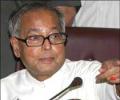
While Finance Minister Pranab Mukherjee is aiming for a return to the path of fiscal prudence, various departments of the central government appear to be out of sync.


Finance Minister Nirmala Sitharaman on Wednesday said the Union Budget strikes a fine balance between growth, employment, and fiscal consolidation, and promotes cooperative federalism. Replying to the discussion on the Union Budget 2024-25 and Union Territory of Jammu and Kashmir Budget in Rajya Sabha, the minister said the government is on track to achieve the pre-announced fiscal deficit target of 4.5 per cent by 2025-26. Sitharaman, also a former defence minister, said the Agniveer Scheme to recruit people in the age group of 17.5 to 21 years, is aimed at keeping the armed forces fit, young and battle-ready.

'Nearly 10 million people will benefit from the increase in the rebate limit for those earning up to Rs 12 lakh.' 'We expect all that money will come back into the economy in either savings, consumption, or investments.'
In the corresponding period of the last financial year, fiscal deficit was 39.4 per cent of the estimates.

New lower GST rates kicked in from Monday, resulting in a slashing of prices of as many as 375 items ranging from toothpaste and shampoo to cars and television sets, a move seen as an attempt to boost consumption to cushion an economy facing tariff headwinds. Tax rates of 5, 12, 18, and 28 per cent have been clubbed into two rates of 5 per cent and 18 per cent, resulting in a reduced price of 99 per cent of daily use items.
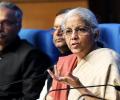
The eighth Budget of Finance Minister Nirmala Sitharaman continued to focus on 'GYAN' (Garib, Youth, Annadata, Nari) to maintain a consistent and coherent strategy initiated over the years in pursuing the government's vision for Viksit Bharat. The approach, characterised by incremental yet impactful steps, aims to create a compounding effect over time.

The outlay for defence sector almost remained unchanged compared to what was allocated in the interim budget on February 1.

The Centre may overshoot the Rs 56,260 crore target for dividend receipts from central public-sector enterprises (CPSEs) set for FY25 and is likely to end up getting around Rs 65,000 crore this financial year, according to a senior government official. This excludes dividend from nationalised banks and financial institutions. As on October 21, the Centre collected Rs 28,913 crore as dividend and other investment from CPSEs, accounting for over 50 per cent of the Budget Estimate for FY25.

Deloitte on Thursday projected economic growth at 6.5-6.7 per cent for the current fiscal, as tax incentives provided in the Budget are expected to push domestic demand amid an uncertain global trade environment. Deloitte estimated India's GDP growth at 6.3-6.5 per cent for FY25 and said that the economic outlook for FY26 hinges on a delicate balance between evolving trade relations and government efforts to boost domestic consumer demand.

The number of centrally sponsored schemes have increased to 35 in FY22 from 30 in FY21 and central sector schemes have increased to 704 from 685 in the previous year, reports Dilasha Seth.

Scrapping Plan and non-Plan classifications necessitates the change

The Centre's fiscal deficit, the gap between the government's expenditure and income, stood at Rs 1 trillion during April-May, constituting over one-fourth of the budget estimate for the entire 2010-11 fiscal.
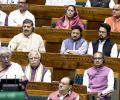
Finance Minister Nirmala Sitharaman on Tuesday announced income tax relief for the middle class, a Rs 2 lakh crore outlay for job creation schemes over the next five years and a spending splurge for states run by her party's new coalition partners as she unveiled the Modi 3.0 government's first budget after the general elections.

Here are the key numbers to watch out for in the Budget for 2022-23, which is widely expected to boost spending towards policies that create jobs, boost manufacturing, helping rural and agri-economy and infrastructure creation. Sitharaman, who had in her first budget in 2019 replaced leather briefcase -- which had been in use for decades for carrying budget documents -- with a traditional red cloth 'bahi-khata', has spurt in tax collections to her aid in the budget that is expected to a spend-all budget.

'Currently, it takes between two and three years to formulate the request for proposal for procuring specific military equipment for the armed forces. It should not be this way.'

The Delhi government's budget size for 2022-23 was Rs 75,800 crore and Rs 69,000 crore in the preceding year.

China showcased its latest military hardware, including hypersonic and ballistic missiles, during a parade commemorating the 80th anniversary of its victory against Japanese aggression in World War II. President Xi Jinping called for world peace and national rejuvenation.
To help compare numbers better, FinMin might retain the interim Budget Estimates with the new ones.

The idea is to get the budget passed by Parliament along with Appropriations Bill and the Finance Bill by the end of March as this would ensure implementation of the Budget proposals from April 1.

India has allocated Rs 1.72 trillion, or 27.67 per cent of the total defence budget to cater to modernisation of the country's arsenal. Modern militaries spend up to 50 to 60 per cent of their total defence budget so that they go into combat with superior weaponry and equipment.
